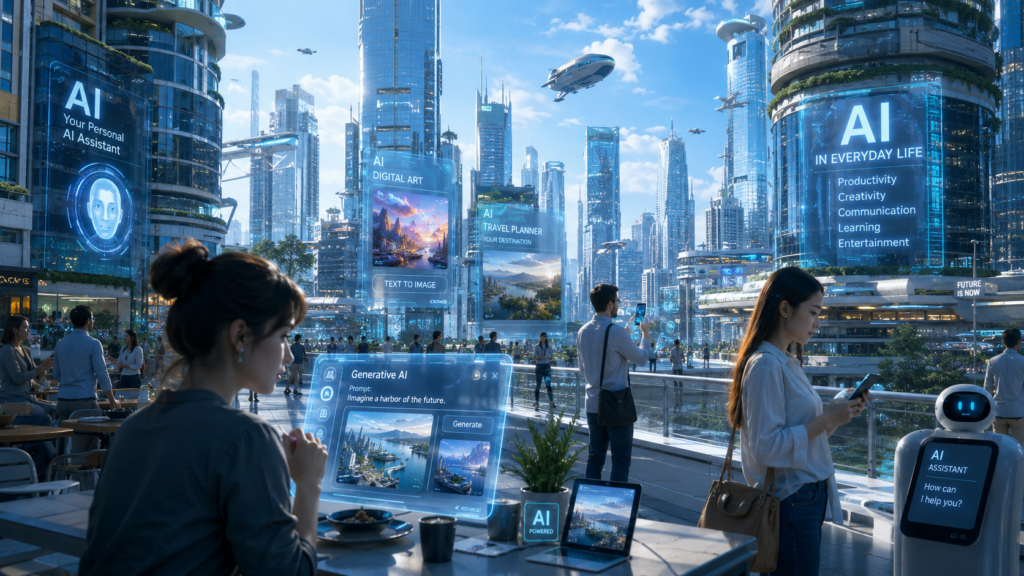
Generative Artificial Intelligence (Generative AI) is rapidly transforming the way people live, work, learn, and communicate. Unlike traditional software that follows predefined rules, generative AI can create content, generate ideas, answer questions, write text, produce images, compose music, and even assist with complex decision-making. What was once considered futuristic technology is now becoming a part of everyday life for millions of people around the world.
Personal Productivity and Daily Assistance
One of the most visible impacts of generative AI is in personal productivity. AI-powered assistants can help users manage schedules, draft emails, summarize documents, create to-do lists, and answer questions instantly. Instead of spending hours organizing information or searching through multiple sources, people can use AI tools to complete tasks in minutes.
For example, professionals use AI to prepare reports, create presentations, and generate meeting summaries. Students use it to understand difficult concepts, create study notes, and organize research. Even simple daily tasks such as planning meals, managing budgets, or creating shopping lists can be streamlined with AI assistance.
As AI becomes more integrated into smartphones, laptops, and smart home devices, it is evolving into a digital companion that helps people stay organized and efficient throughout the day.
Revolutionizing Learning and Education
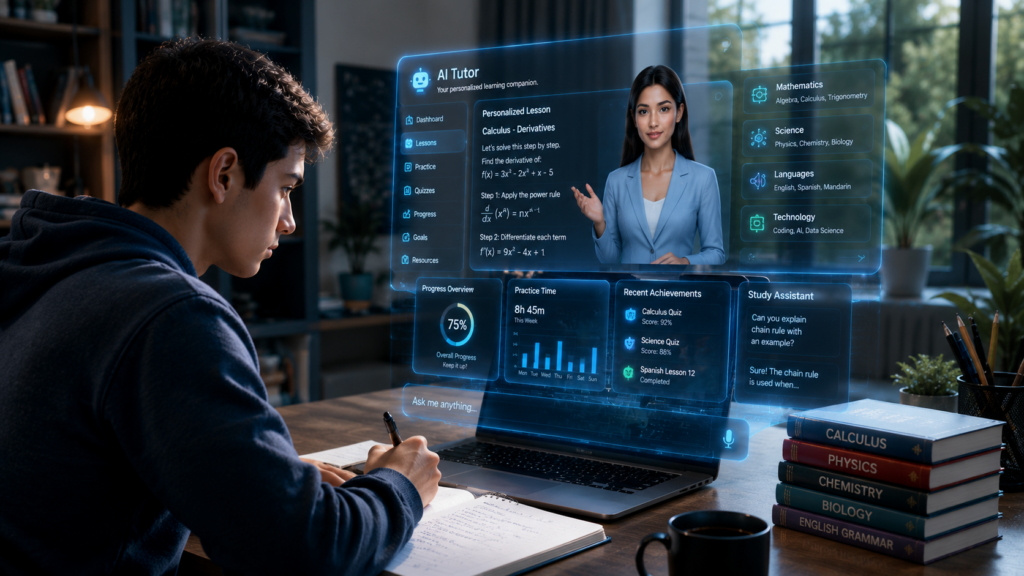
Education is experiencing a major transformation through generative AI. Traditional learning methods often provide the same material to every student, regardless of their individual needs. AI can personalize learning experiences by adapting explanations, examples, and exercises to match a student’s skill level and learning style.
Students can ask questions in natural language and receive immediate, detailed explanations. AI tutors are available 24/7, helping learners practice languages, solve mathematical problems, understand scientific concepts, and prepare for exams.
Teachers also benefit from AI by generating lesson plans, quizzes, educational content, and classroom materials. This reduces administrative workload and allows educators to focus more on teaching and student engagement.
The result is a more accessible and personalized educational experience that supports lifelong learning.
Enhancing Creativity and Content Creation
Generative AI is empowering people to become creators, regardless of their technical expertise. Writers can generate ideas, overcome creative blocks, and improve their drafts. Designers can create visual concepts, illustrations, and marketing materials in a fraction of the time previously required.
Artists use AI to explore new creative possibilities, while musicians experiment with AI-generated melodies and compositions. Video creators can generate scripts, voiceovers, subtitles, and visual effects more efficiently.
Importantly, AI is not replacing human creativity. Instead, it acts as a creative partner that accelerates workflows and expands possibilities. Individuals who previously lacked specialized skills can now create professional-quality content with the help of AI-powered tools.
Improving Communication
Communication has become easier and more effective with generative AI. Language barriers that once limited global collaboration are gradually disappearing thanks to AI-powered translation and language assistance tools.
People can instantly translate messages, documents, and conversations into multiple languages. AI can also help improve grammar, rewrite text for different audiences, and adjust tone for professional or casual communication.
Businesses use AI chatbots to provide customer support around the clock, answering common questions and resolving issues quickly. Consumers benefit from faster responses and improved service experiences.
These capabilities are helping individuals and organizations communicate more clearly, efficiently, and inclusively.
Transforming the Workplace
Generative AI is changing how work gets done across industries. Employees spend a significant portion of their time on repetitive tasks such as data entry, document preparation, and information retrieval. AI can automate many of these activities, allowing workers to focus on higher-value responsibilities.
In marketing, AI generates advertising copy, social media posts, and campaign ideas. In software development, AI assists programmers by generating code, identifying bugs, and suggesting improvements. In healthcare, AI helps summarize patient records and support medical documentation. In finance, it assists with reporting, analysis, and forecasting.
Rather than replacing entire jobs, generative AI is increasingly serving as a productivity tool that augments human capabilities. Workers who learn to collaborate effectively with AI can often achieve better results in less time.

Smarter Shopping and Consumer Experiences
Consumers are also benefiting from AI-powered shopping experiences. Generative AI can recommend products based on preferences, compare options, answer questions about features, and provide personalized suggestions.
Online retailers use AI to create customized shopping journeys, helping customers discover products that match their needs. AI can generate product descriptions, review summaries, and buying guides, making purchasing decisions easier and more informed.
Virtual assistants can even help plan vacations, recommend restaurants, and suggest entertainment options based on individual interests.
Advancing Healthcare and Wellness
Healthcare is another area where generative AI is making a significant impact. Patients can use AI-powered tools to access health information, understand medical terminology, and receive guidance on general wellness topics.
Healthcare professionals use AI to reduce paperwork, summarize clinical notes, and organize medical information more efficiently. This can help save valuable time and improve patient care.
AI is also supporting mental wellness through conversational tools that provide emotional support, mindfulness exercises, and stress-management techniques. While AI cannot replace healthcare professionals, it can complement existing services and improve accessibility.
Challenges and Responsible Use
Despite its many benefits, generative AI also presents challenges. Concerns about misinformation, privacy, data security, and ethical use remain important considerations. AI-generated content may sometimes contain inaccuracies, requiring users to verify information carefully.
There are also questions about intellectual property, transparency, and the impact of automation on employment. Governments, businesses, and technology developers are working to establish guidelines that encourage responsible AI development and use.
Digital literacy is becoming increasingly important so that people can understand both the capabilities and limitations of AI systems.
The Future of Everyday AI
Generative AI is moving beyond being a specialized technology and becoming a fundamental part of everyday life. From helping people work more efficiently and learn more effectively to enhancing creativity and communication, AI is reshaping how individuals interact with technology.
As AI systems continue to improve, they will become more personalized, intuitive, and integrated into daily routines. The future is likely to feature AI assistants that understand context, anticipate needs, and provide seamless support across multiple aspects of life.
Generative AI is not simply changing the tools people use—it is changing the way people think, create, learn, and solve problems. Those who embrace this technology responsibly will be better positioned to benefit from a future where human intelligence and artificial intelligence work together to achieve more than either could alone.